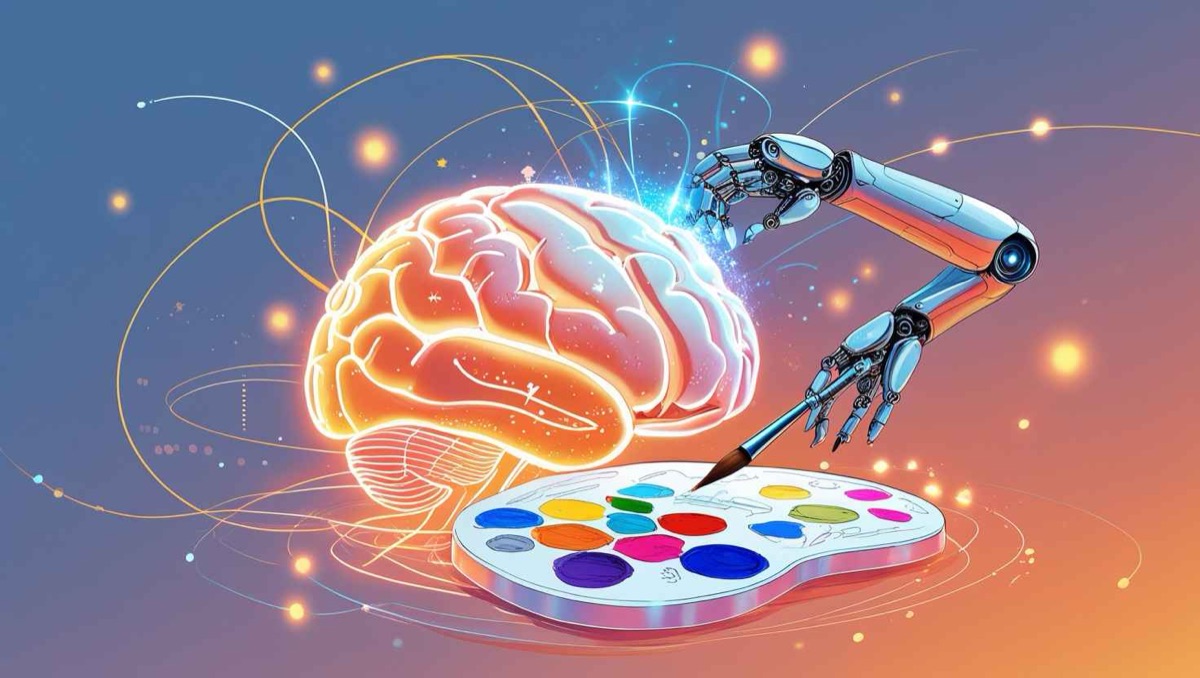
Artificial intelligence was, for most of its history, a tool for logical problems: optimise this route, classify this record, automate this task. Its arrival in the creative domain was the genuinely unexpected turn — and it has forced a more interesting question than "can a machine be creative?"
The question that actually matters to anyone making things for a living is narrower and more practical: which parts of creative work are worth handing over, and which parts stop being the work if you do?

Where the tools genuinely changed the job
Generative systems now produce competent images, music, prose, video and 3D assets from a description. The interesting part is not the output quality, which improves on its own schedule. It is what the tools did to the shape of creative work.
- Iteration got cheap. The cost of exploring the twentieth variation used to be the reason nobody explored it. When a rough version of an idea costs seconds, the exploration phase widens dramatically — and exploration is where most good work is actually found.
- The blank page mostly stopped existing. Something to react to is easier than something to originate. A great deal of the practical value is simply having a first draft to reject.
- Production work compressed. Resizing, variants, cleanup, versioning for six formats — the unglamorous majority of commercial creative work — collapsed in cost far more than the conceptual work did.
- The bottleneck moved to judgement. When generating options is free, the scarce skill becomes knowing which option is good and why. That skill did not get cheaper. If anything it got more valuable.
The questions that are still open
The genuine difficulties here are not technical, and pretending they are settled does nobody a favour.
- Ownership and rights. Who holds the rights to a generated work, and what is the status of the material a model was trained on? This is being contested in courts and legislatures rather than resolved, and the answers differ by jurisdiction. If you are using generated assets commercially, this is a question for your lawyer and your vendor's indemnity terms — not for a blog post.
- Provenance and disclosure. Marking synthetic content is moving from courtesy to obligation. Under the EU AI Act, generative systems must mark outputs machine-readably, and deployers must disclose synthetic media in a range of cases — a duty that arrived on 2 August 2026.
- Homogenisation. Models trained on what exists are biased toward what exists. Used carelessly at scale, they pull output toward a competent average — and the average is precisely what distinctive work is trying to escape.
- Displacement. The impact has fallen unevenly. Conceptual and directorial roles have largely held; production and mid-tier commissioned work has not. Treating this as settled in either direction is premature.

What this means for people building creative tools
Most of the durable value is not in the generation step, which is a commodity available to everyone through the same handful of providers. It is in everything around it.
The products that stuck gave people control: the ability to constrain output to a brand, to iterate on a specific region rather than regenerate wholesale, to keep a version history, to work inside the tool they already use. Those are software problems — state management, integration, interface design — and they are what separates a demo from something a studio adopts.
Nobody's competitive advantage is access to a generative model. Everyone has that. The advantage is in the workflow you build around it.
The realistic conclusion
Generative tools did not replace creative work and did not turn everyone into an artist. What they did was shift where the effort goes: less time producing options, more time judging them; less time on execution, more on direction and constraint.
That is a real change and a manageable one. It rewards people who know what good looks like — which is, and always was, the hard part.
We build creative and generative tooling that fits how teams actually work. Start a conversation.